Archive for the Automobiles Category

ACTING LIKE A RACECAR DRIVER: 10 FAST THESPIANS

Posted in Automobiles on February 16, 2012 by RickNews

Turn on the TV or pop-in a Blu-ray and chances are you’ll see a car chase: actors choreographed with precision as high speeds and giant crashes seem to have no consequences on hairdos, makeup or designer clothing. When the action’s done, the director yells “cut” and the danger is turned “off” for the moment. Yet, there are some actors for whom the ersatz cannot cut it—their need for speed is so great that they must risk pretty faces and lucrative contracts to satisfy a jones for “faster.” Here is a random list of ten of Hollywood’s fastest men:

The one, the only–hail to the McQueen!

STEVE MCQUEEN—The coolest man who ever lived wasn’t just a damn good thespian; he was also a terrific racecar driver and motorcyclist. McQueen’s love for speed permeated almost every aspect of his life. When he wasn’t on horseback for one of his many Western roles, he was in the seat of a dirt bike. If McQueen wasn’t on a cycle, he was in a racing car—and he was so enamored of the sport that he sunk millions of his own money to fund the seminal 1970 movie, LeMans. In it, McQueen plays (what else?) a cool racer who manhandles a Porsche 908 for 24 hours, straight. In real life, McQueen partnered with Peter Revson for the 1970 12 Hours of Sebring and they won their class! McQueen also had legendary taste in road cars: four years ago, one of McQueen’s Ferraris sold at auction for over $2 million. A Porsche 911 that he drove in the opening scene of LeMans just sold for $1.3 million. McQueen can also be credited for the first (and greatest) car chase in modern cinema history. His Bullitt not only set the standard for such pursuits, but it’s imprinted so indelibly on the cultural landscape that even 40 years onward, Ford actually produced a “Bullitt Edition” Mustang.

He plays a doctor on TV…and his real life is even more exciting.

PATRICK DEMPSEY—Women call this star of TV’s Grey’s Anatomy, “McDreamy,” yet it’s more appropriate to call him, “McSpeedy.” Since appearing on the radar screen in the late-‘80s, Dempsey starred in several movies, including In The Mood, Mobsters, Made of Honor, and Sweet Home Alabama. Yet, his TV success thrust Dempsey into the spotlight in recent years, which meant only good things for his racing ambitions. Dempsey started in off-road competition, but his recent love has been Grand-Am road racing, in closed-cockpit cars, such as the Mazda RX-8 fielded by Dempsey Racing in the Rolex Sports Car Series. In 2009, Patrick co-drove a Ferrari F430 in the 24 Hours of LeMans and finished a respectable ninth in his class. In the 2011 24 Hours of Daytona, Dempsey placed third in his class. Clearly this Maine-born heartthrob can make engines red-line, in addition to hearts.

Acting, salad dressing, and racing–a success in all three.

PAUL NEWMAN—Paul Newman was a legendary actor, entrepreneur, philanthropist, racecar driver, and racing team owner. This blue-eyed movie star took up racing during the filming of Winning, which co-starred his wife, Joanne Woodward. During the 1970s, Newman tore up the tracks in the IMSA road racing series, famously helming a red-white-and-blue Datsun 280X. Later, he partnered with Carl Haas to form the Newman-Haas Indycar racing team, which won championships with Mario Andretti driving. However, Newman didn’t give up driving for fun and sport. He drove well into his 70s and he last took the wheel of a racecar a few months before he died. Truly, for Paul Newman, racing was life.

Fast Frankie.

FRANKIE MUNIZ—Best known as the title character in the early-2000s TV sitcom, Malcolm in the Middle, Frankie Muniz now spends his days as a “professional racecar driver.” (His description.) In 2005, Frankie won the Long Beach Grand Prix’s Celebrity Race, and that kickstarted his on-track endeavors. The following year, Muniz decided to put his acting career on hold in order to compete in the Formula Atlantic Championship series, which look like miniature Formula One cars, complete with open wheels and massive wings. However, Frankie’s prowess on the track pales in comparison to his success as an actor. He finished 2008’s season placed eleventh in the standings and in 2009, he came in ninth. It seems the 26 year old actor may have hung up his “professional” helmet because his Web site hasn’t had any news about his exploits in over two years. Maybe his next starring vehicle will be Malcolm in Last Place

Jason jammed his car into the wall at a high speed…and luckily lived.

JASON PRIESTLEY—Another staple of the FOX Network, actor Jason Priestley starred in the seminal 1990s shlockfest TV show, Beverly Hills 90210. In the series, rich, young people focused on such important issues as hair mousse and the proper way to rip a pair of designer jeans. Jason Priestley, feeling the desire to go faster, began his racing life in a Toyota rally car in the mid-90s. Yet, the taste for speed drew the Canadian actor toward open-wheel Indy Lights racecars. These paired-down speed machines are similar to the ground missiles that compete in the Indy “500.” However, even one of these babies was too much for Jason: in August of 2002, he crashed his car into a wall, going over 180 mph, at Kentucky Speedway. Luckily, Priestley wasn’t killed; he did, however, spend months convalescing, with broken bones. Now, Jason’s sights are away from the cockpit and more towards owning a race team. Smart move.

“Tom, the Cruise control button is on your left..”

TOM CRUISE—This “legend of modern times” just completed a demonstration test of a Red Bull Formula One car in California, where he was just four seconds slower around the track than an experienced F1 pilotte. Last year, Cruise went on the world’s most popular car TV show, Top Gear, and set the fastest celebrity lap time. Say what you will about his antics on Oprah, but Tom Cruise is among Tinseltown’s fastest racers. Story has it that Cruise got the “speed bug” from his Color of Money co-star, Paul Newman. Cruise went on to star in Days of Thunder, a 1990 flick about a NASCAR driver with the greatest name ever: Cole Trickle. Yet Cruise didn’t limit himself to ovals: he became an accomplished SSCA road racer. TC also has a passion for motorcycles, with Ducati and Confederate his preferred brands. Cruise control, indeed.

The Dean of young and tragic thespians.

JAMES DEAN—Perhaps the most famous casualty of Hollywood’s “need for speed,” James Dean still serves as the poster boy for road safety over a half century after his passing. A young actor who rose to star status in a few short years, James Dean patented and bottled “cool.” Dean first tasted speed with an MG TD that he raced around California. He was pretty good, too, placing second in a Porsche 356 at the Palm Springs Road Races in 1955. James Dean soon upgraded to a lightweight Porsche 550 Spyder nicknamed “Little Bastard”—a “silver bullet” of a car that, in the mid-1950s, ran rings around lumbering Corvettes. Only 90 of these speed demons were ever made and it was in this car that he met his fate in the form of a 1950 Ford driven by a college student on Route 466. James Dean died at age 24, behind the wheel of a Porsche. What a way to go, but nevertheless too soon.

Contrary to popular belief, Garner didn’t race a Maverick.

JAMES GARNER—He’s best remembered for his TV roles as cowboy Brett Maverick and private dick Jim Rockford, but James Garner also starred in the 1966 classic movie, Grand Prix. As a cocksure American competing against English Dukes and Italian Counts, Garner personified Yankee confidence. In real life, Garner raced cars and was also owner of American International Racers, which fielded entries at Daytona, LeMans, and Sebring. He also signed a contract with American Motors for him to enter 10 of their cars for the Baja “1000” off-road race in 1969. Interesting fact: James Garner drove the pace car in the Indianapolis “500” three times.

Jackie was a “superman” in a Healey.

JACKIE COOPER—This former “Our Gang” cast member recently passed away at age 88. With an acting career spanning from silent films to the Christopher Reeve-era Superman movies, Jackie Cooper is a sentimental favorite on the American cultural landscape. Yet few remember that Jackie had a love for fast cars. In 1955, Cooper personally commissioned Donald Healey to build him a racing 100S, which was among the first to arrive in America. At the 12 Hours of Sebring that year, Jackie suffered an electrical failure near the end and had to push the car over one mile in order to complete the race. A plucky kid star had turned into a fierce competitor with mettle, and racing was to thank for it.

Tool Time? Nope, it’s trophy time for Allen.

TIM ALLEN—People remember Tim Allen as the “Tim the Toolman” on the hit TV series, Home Improvement, yet this Detroiter always held fast cars close to his heart. Shortly after he was signed for HI, Allen started a racing team with legendary car tuner Steve Saleen. Known for his aggressive Mustangs that transformed ordinary Fords into supercars, Saleen prepared a duo of ‘Stangs for the company, with Allen helming one.  While Tim didn’t light the tracks on fire, he did start his own car customizing company, Tim Allen Designs. The emphasis is on—what else?—American iron and Allen’s hot rods are just as audience-appealing as his other pursuits.

Speedy Swede

Posted in Automobiles on February 15, 2012 by RickNews

This article appeared in Elements Magazine in 2008. 


This ain't your Aunt Janice's Swedish car.

The Swedish are known for the furniture store, IKEA, for tasty meatballs, and for building safe and boxy cars, like Volvos. Yet few know that the Swedes also produce the second-fastest car on earth (next to the Bugatti Veyron 16.4)! The car is the Koenigsegg CCX, and it’s designed and handcrafted in Angelholm, Sweden, to be the most brash and outrageous supercar on the planet.

Dreaming Big

Company founder Christian von Koenigsegg comes from a wealthy family and when he dreamt about having his own automobile company, the coffers were full enough to turn those dreams into reality. In 1994, at the age of 27, Christian founded Koenigsegg Automotive and immediately set to work on designing an uncompromising supercar. In 2000, the CC8S debuted to a stunned auto world that thought the Swedes were only good at Saabs and Volvos. The creation was relatively compact, unlike a longish Ferrari or Lamborghini; it was relatively “simple” in terms of electronic “nannies,” unlike an all-wheel-drive Porsche; and it looked like it could just scare anything off the road. The CC8S was the foundation upon which Koenigsegg stands.

Festooned with myriad cooling vents, the CCX means business from any angle.

Starting at a million dollars even, the Koenigsegg is a very, very rare car, and official US sales are handled by Exotic Cars of Caesar’s Palace, in Las Vegas. There are three different models produced: the CCX, the CCXR, and the Edition. The CCX is powered by a 4.7-liter V8 engine that’s twin-supercharged. This powerplant is custom built for Koenigsegg in England, by a company that makes Formula One racecar components. The CCXR is essentially the same car, but its engine is modified to run on E85 fuel. That’s right—this is the world’s first environmentally conscious supercar. Running on Ethanol, the CCXR boasts 1,018 horsepower, which is 17 more ponies than the Bugatti Veyron. (Owners of the CCX can have their engines converted to run on E85 for only $100,000.) The Edition is Koenigsegg’s record-breaking piece de resistance: It has improved aerodynamics for high-speed runs, the carbon fiber body is left unpainted so the weave can be admired by all, and a paddle-shift transmission supplants the standard six-speed manual. The bad news: only 14 of the CCX Edition and six of the CCXR Edition will be constructed.

Simply Swedish

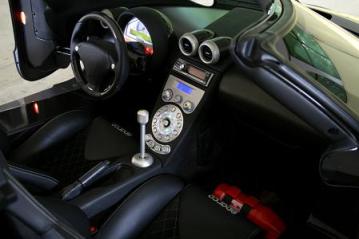
Koenigsegg’s design philosophy is refreshing simple in that the body is relatively free of extraneous “go-faster goodies,” such as massive winged spoilers and “look at me” side skirts. There’s just that one ginormous side intake that looks as if a small child could disappear in it. One concession to supercar fashion, however, is the CCX’s “scissor doors,” which lift upward yet offer better ingress/egress than Lamborghini’s or Mercedes-Benz’s similar portals. The “Swedish Simple” philosophy extends to the interior, which informs the observer that this beast is no kit car or homemade garage special—nor is it unnecessarily cosseting. The dashboard is dominated by an aluminum “pod” that looks like it was appropriated from a crashed UFO. (The pod even has a name befitting a million-dollar car: the Koenigsegg Chronograph Direct-Focus Instrument Cluster!) The leather seats conceal carbon fiber frames and are made by the racing supplier, Sparco. For open-air motoring, the CCX features a lift-off roof panel that can be stored in the front trunk. Yes, it’s cozy inside for two lucky people, but remember that this is essentially a racing car for the road.

In the belly of the beast.

Michael Nelson, General Sales Manager of Exotic Cars of Caesar’s Palace, states that their dealership delivered five CCXs in 2007 and in 2008, two have been delivered through May. When queried on just who buys these cars, Mr. Nelson says that the “typical” Koenigsegg buyer is a car collector with many rides. As for options on this bespoke motorcar, it mainly falls into the cosmetic (monochromatic paint schemes, naked carbon fiber) and the indulgent (custom-colored headliners, upgraded sound systems, reversing cameras, etc.). When asked about servicing, Nelson replied that the Koenigsegg factory is training independent exotic car mechanics from around the US at the company’s factory in Sweden. This way, if you live in New York, for example, and need service, there is a designated northeastern service center to handle your needs. Yet, Mr. Nelson cannot recall one instance in which a CCX was brought in for repair. (Try that with a Ferrari dealer.)

“What Was That?”

 The Koenigsegg CCX offers a different kind of experience than, say, a Bugatti. With the Veyron 16.4, which is about $1.4 million, it’s, “Look at me, I’m driving the most expensive car in the world…and it’s two-toned.” With the CCX, the vibe is more of a, “What the heck was that thing?!” Few have heard of Koenigsegg and even fewer still can identify one in photos, much less when it blasts past on the road. For some, who eschew logos on their clothing or handbags, and who wish to exude “silent luxury,” a Bugatti or a Ferrari Enzo wouldn’t even be considered. No, for some, only a Swedish supercar will suffice.

Shaped for speed.

KOENIGSEGG CCX Specifications

  • 0 to 60 mph: 3.0 seconds
  • Top Speed: 245 mph
  • Drivetrain: 4.7-liter, twin-supercharged V-8, 6-speed manual, rear-wheel drive
  • Total Power: 806 horsepower; 678 pound-feet of torque
  • Base Price: $1,000,000

Because All Current Aston Martins….

Posted in Automobiles on February 14, 2012 by RickNews

…Are outdated and all three model lines look like an automobile that debuted in 2005, the new James Bond flick, Skyfall, will make use of a nearly 50-year-old DB5…

Check out the full article, from The Sun, here.

The second-best "Bond" next to the best "Bond" car.

Family Hauler

Posted in Automobiles on February 14, 2012 by RickNews

This article appeared in Elements Magazine in 2009.

We interrupt this issue of Elements for breaking news: the temperature in Hades is now 32 degrees Fahrenheit because Porsche has built a four-door sedan. A few years ago, the Stuttgart-based car manufacturer and current de facto owner of Volkswagen, set autodom on its ear when it introduced a truck, the Cayenne. Consequently, Porsche changed its image from a sports car company devoted to racing success to a full-range automotive manufacturer aimed at pleasing all members of a well-heeled North Shore family, with their new Panamera sedan.

From the front, the Panamera has all the familiar Porsche family cues.

The Porsche Panamera is a four-door car based on the underpinnings of the Cayenne SUV. Engines are either a 4.8-liter V8 with 400 horsepower, or a twin-turbo version of the same engine, developing 500 horses, mated to a 7-speed automatic with paddle shifters on the steering wheel. As with the 911 sports coupe, the Panamera is available in either two-wheel drive or as an all-wheel driver (on the 4S and Turbo models). While the technical bits are competitive with almost any luxury four-door on the planet, it’s the design of the vehicle that’s raising blood pressures.

Controversial Contours

From the side, things get more...interesting.

The Panamera’s face is perhaps the “cleanest” of all Porsches, bar the Boxster. The headlights are wind-shaped jewels, complimented by blades of LED running lights under each. Aft of the front wheels, the wheelarches end in a vent/side indicator light that’s distinctly un-Porschelike. The door/window shapes seem ungainly, with quarterlights in both the front windows and rears. It’s the rear door that seems to capture the viewer’s eye, as the upswept window visually accentuates the heavy doorframe. (Maybe that’s why the “baubles” near the front wheels were added—to take the eye away from such things.) The Panamera’s caboose is perhaps the most controversial aspect of the car in that the longish vehicle comes to a rather stubby end, with the main focal points being the shutlines of the enormous hatchback door. Incidentally, fitted on the hatch is an electrically-operated spoiler which deploys at speed, just like the ones on a 911 or a Boxster. The base Panamera S comes standard with 18-inch wheels, yet 19s and 20s are optional.

However, at the rear, things take a turn for the worse.

 Porsche enthusiasts will recall that most of the automaker’s interiors were quite austere up until, well, 1999—black vinyl, a tinny-sounding radio, and haphazard switchgear were the hallmarks of the 911 range since its inception. However, the Panamera boasts optional 8-way adjustable rear seats and optional front 18-way perches with adaptive air bladders that support occupants during exuberant cornering. Naturally, there’s a standard navigation system, a high-quality sound system, and if the buyer so chooses, leather absolutely everywhere. A 1,000-watt audio upgrade, sourced from Burmester (purveyor to sister brand Bugatti), is available for $5,700. Deviating from tradition, the center console that separates driver and passenger is festooned with buttons in such a way that the Space Shuttle’s bridge comes to mind. There are controls for stability management, traction control, and even for the air suspension’s ride quality. Yet, unlike a BMW M5 or a Mercedes S-class AMG, the Panamera is strictly a four-seater. The overall feel is that of a cockpit in front and another one in back.

The best part about the interior is that one doesn't have to view the exterior.

Pay (and Pay) to Play

 Speaking of options, this is a Porsche, and for the longest time, the German automaker has had a reputation of charging big bucks for almost every single option that would be standard on competitors’ offerings. While a rear wiper may be gratis on a Kia, the people from Stuttgart charge $360 for such a device. Partial leather seating is what your Pana comes with, at no charge, yet full-leather, 18-way thrones along with a leather dashboard and door covers is an eye-watering $7,000 option. (You can heat those seats for just $500 more.) Keyless entry and drive-away via a pocket transmitter is $1,000. Ceramic brakes? Only $8,000. Ticking “sport exhaust” on the options sheet incurs a $3,000 charge. Need a rear fridge? No problem—for $2,500. Will red seat belts scratch your itch for such an item? That’ll be $850. Those of you who want the headlight washer stems painted to match the body color will have to cough up $300 for this accoutrement. Enjoy talking on the phone in your car? A Bluetooth interface is but $700. Finally, you can have the air conditioning vents leather-wrapped for just $1,500. Using the online Porsche options configurator, I was able to add $74,000 worth of baubles on top of a Panamera S’ base price of $89,800. Sort of makes a Bentley Flying Spur seem like a bargain…

Unlike Porsches of the past, the Panny's perch pampers.

As for driving the Teutonic Titan, the overall feel is between a Maserati Quattroporte and the Benz S63 AMG. While the Panamera isn’t as rigid over road ruts as the Maser, it’s still more of a “driver’s car” than the behemoth Benz. One area where Porsche excels over its rivals is in weight management because the Panamera tips the scales at around the two-ton mark—surprisingly lightweight in this market segment. (The S63 weighs in at about a half-ton heavier.) The engine power is as expected of a Porsche—perhaps the only thing about the Panamera that isn’t a surprise. The S’ standard powerplant propels this four-door to 60 mph in just over five seconds, while the Turbo’s nuclear reactor can motivate the Panamera to the same velocity in under four seconds with the optional Sport Chrono Turbo package. To put things into perspective, that’s only slightly slower than the much smaller 911 Turbo..! However, the Panamera isn’t all about excess because it’s the first automatic-transmission car in the US to receive fuel-saving start/stop technology. When the Pana comes to a dead stop, the engine shuts off; release the brake, press the “go” pedal and the car roars to life immediately.

The Panamera Turbo S's corral...where 500 horsies reside.

The Panamera was created to fill a market niche for Porsche, pure and simple. BMW hot-rodded sedans (the M3 and M5) with sales success; Benz has a few fast four-doors with AMG badging; and even Maserati has a popular sedan, the Quattroporte. Porsche had to get in on the profits with its own high-tech executive express. Certainly, the timing for such a bold move could be better, yet die-hard Porschephiles will have their interest piqued by the Panamera. So will those on the road behind one.


2010 PORSCHE PANAMERA Specifications

  • 0 to 60 mph: 5.2 seconds (Panamera S); 4.8 seconds (Panamera 4S); 4 seconds (Panamera Turbo); 3.8 seconds (Turbo with Sport Chrono Turbo package)
  • Drivetrains: 4.8-liter V-8 either normally aspirated or twin-turbocharged, 400 horsepower or 500 horsepower (for Turbo); rear-wheel drive or four-wheel drive (on Panamera 4S and Turbo)
  • Transmission: 7-speed, dual-clutch, paddle-shift automatic
  • Top Speeds: 175 mph (Panamera and Panamera 4S); 188 mph (Panamera Turbo)
  • Base Prices: $89,800 (Panamera); $93,800 (Panamera 4S); $132,600 (Panamera Turbo)

Meanwhile, Chevy Can’t Even Sell An Electric Car….

Posted in Automobiles on February 13, 2012 by RickNews

I just saw this on Autoblog.com, about Toyota’s largest luxury car…

Next Toyota Avalon to Best Fiat 500’s Fuel Economy?

Fiat 500

The Fiat 500 is 139 inches of A-segment fury, with a heaping dose of cute and a dash of fuel efficiency. In fact, the manual transmission-equipped cinquecento averages 33 miles per gallon in mixed driving, which is better than most things on the road.

Impressed? Toyota isn’t. The Detroit Free Press reports that the Japanese automaker told dealers at the National Automobile Dealers Association meeting in Las Vegas, NV recently that the next generation Avalon will get better fuel economy than the wee Fiat.

Since the current generation Avalon is five feet longer and considerably wider than the 500, that’s an impressive claim. Heck, the Avalon is bigger than the Camry, and buyers currently have to step into a Camry Hybrid model to surpass the fuel economy numbers of the pint-sized Fiat.

The sky-high fuel economy of the Avalon wasn’t the only good news Toyota delivered to dealers. The automaker reportedly informed the car-selling audience that 19 new models were coming in 2012.

Road Rapture

Posted in Automobiles on February 13, 2012 by RickNews

This article appeared in Elements Magazine in 2008.

With matte paint and angular lines, the Reventon looks like a fighter jet for traffic jams.

There are some people for whom the ordinary will not suffice. For these particular persons, only the “distinct” will do. We’ve seen them around, flashing an LG Prada mobile phone or fumbling through a limited edition Gucci carryall. Yet, there are some top-of-the-line Lamborghini Murciélago LP640 owners who believe their car just isn’t distinctive enough. For that, the Italian automaker launched a program to create the wildest and craziest car in their history, and for motivation, Lamborghini looked not to other wheeled vehicles, but to the skies.

Even from the side/rear, this is one unique Lambo.

Raging Raptor

The inspiration for the new, $1.4-million Lamborghini Reventón supercar is the latest, most high-tech military fighter aircraft in existence, the F-22 Raptor. Lambo’s director of design, Manfred Fitzgerald, wanted to emulate the raw, technological “edge” of the Raptor in an automobile, and doing that took the Audi-owned, Sant’ Agata Bolognese-based carmaker in a direction previously never seen on the roads—of this planet, at least. With sharp creases and obtuse angles in its carbon fiber body, the new Reventón is perhaps the most striking supercar since the 1970s Lamborghini Countach. Says Stephan Winkelmann, Lamborghini President and CEO, “The Reventón is the most extreme of all.” In fact, the only parts shared with the Murciélago, on which the Reventón is based, are the doors, side mirrors, and roof. The purposeful, “function over form” styling of the Reventón is, in many minds, the most successful blending of “aircraft chic” and “car cool” ever created. (Hip Tip: The Reventón is named after a particularly fierce and famous Spanish fighting bull of the 1940s.) Couple that with matte green-gray paintwork and you’ve got a car that will easily scare “left lane bandits” over to the right in a hurry. That’s right—you can get the Reventón in any color/finish you like…so long as it’s matte green-gray. After all, banana yellow paint is for a Gallardo.

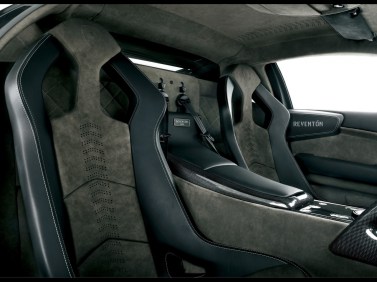
If grey-green suede's your thing, you'll love the Reventon's interior.

Authentic Cockpit

The interior is the other area where Lamborghini drastically deviated from the Murciélago’s fare. After swinging open the scissor doors, one isn’t greeted with the austerity of a military vehicle, but with sumptuous Italian leather and suede-like Alcantara everywhere. Sprinkled about are touches of real aluminum and carbon fiber trim. Behind the flat-bottomed steering wheel are the transmission’s shift paddles and behind that is the Reventón’s revolutionary gauge cluster. Instead of having old-fashioned dials with pointers, the Reventón utilizes three LCD monitors that display a selection of user-chosen speedometer and tachometer readouts. One choice mirrors that of a conventional set-up, with round “analogue” instruments. Another choice boasts a futuristic display with a digital speedometer and a G-Force-Meter with pseudo-military “stencil” markings. The G-Force-Meter shows the dynamic drive forces, longitudinal acceleration during acceleration and braking, as well as transversal acceleration around bends. These forces are represented by the movement of an indicator on a graduated 3D grid, depending on the direction and intensity of the acceleration. The effect is impressive and this driver-selectable arrangement is sure to be featured in future Lambos—it’s that cool.

Taking the "fighter jet cockpit" concept to the instrument panel.

Shock and Awe

Motivating the Reventón is the Murciélago’s V-12, with 6.5 liters of displacement, and mated to a six-speed semi-automatic transmission. The car’s 650 horses are delivered to the pavement through all four wheels (again, like the standard Murc). The Reventón’s 18-inch wheels are also bespoke in that they feature carbon fiber cooling vanes on them to help lower the surface temperatures of the standard ceramic brake rotors. Performance is familiar to a Murciélago owner, with 60 miles an hour appearing in less than four seconds and culminating in a top speed of 211. Lamborghini realized some owners drive their cars on real roads, so they’ve fitted a standard hydraulic system that, with a push of a button, raises the Reventón’s nose so as not to scrape it on a driveway. Another interesting factoid is that the rear lights use special, “heatproof” LED bulbs, due to the massive heat plumes swirling around the car’s rear at speed.

"Heatproof" L.E.D. lights are utilized in the caboose.

Mission Accomplished

At $1.4 million, people will surely lump the Reventón in with Bugatti’s Veyron, but that would be a mistake. The Veyron is a technological showpiece that was created to show the world that a 254-mph car can be built for the “street.” The Reventón, however, was created to show what a smallish, Italian car company could do when buyers don’t care about price. The Reventón is also a car that is more cutting-edge with regards to styling than performance, and Lamborghini itself refers to the car as “haute couture.” Yet, those with over a million bucks to spend—and spend gladly on a car—are out of luck. Lamborghini is only building 20 Reventóns, and all 11 destined for the USA are sold out. In other words, the Reventón is an instant collector car, and as such we probably won’t be seeing a lot of them on Route 25A or the L.I.E., and that would be shame because it’s not often a “raptor” is spied amongst the herd.

 LAMBORGHINI REVENTÓN Specifications

  • 0 to 60 mph: 3.4 seconds
  • Top Speed: 211 mph
  • Drivetrain: 6.5-liter V-12, E-Gear six-speed semi-automatic transmission
  • Total Power: 650 horsepower; 487 pound-feet of torque
  • Base Price: $1,400,000

Bugged-out At 225

Posted in Automobiles on February 11, 2012 by RickNews

A Bugatti Veyron 16.4 owner just posted the video below. As is the case with these YouTube presentations, extremely high speeds are involved…

Oy, Veyron!

Posted in Automobiles on February 11, 2012 by RickNews

This article appeared in Elements Magazine in 2007.


The Veyron 16.4


There are few luxury items that are, unquestionably, the “best” of breed. For umbrellas, Swaine Adeney Brigg makes the best; the best trench coats—undoubtedly Burberry. Yet, for sportscars, debate has raged for almost 50 years, with punters and millionaires alike squabbling whether Porsche, Ferrari, or Lamborghini made the ultimate speed machines. Now, the debate is settled.

The iconic French automaker Bugatti is back in business and their Veyron 16.4 is simply the best sportscar in the world, bar none. It’s also the most expensive production automobile ever, at $1,440,000 a copy. The Veyron is a car made to settle all arguments with regards to excess for the foreseeable future: not only is it the most expensive car, the Bug’s also the fastest, the boldest, and the brashest conveyance ever unleashed on public roads. Ever.

In the early part of the 20th century, Ettore Bugatti’s company constructed some of the most innovative and successful racing cars to date. EB parlayed this success into a road car company that was equally innovative. Ettore viewed his creations as works of art—so very French! Just before the Great Depression, Bugatti created the Royale, a car so exclusive that he would only sell it to monarchs and heads of state. At about $50,000 in 1929, it’s no wonder that only six were ever built. The Bugatti organization didn’t survive World War II, and the marque was revived in the early-1990s in Italy—just in time for the recession. The second coming didn’t fare so well and Volkswagen eventually acquired the Bugatti name and constructed an impressive, state-of-the-art factory on the grounds of Ettore’s former estate in Molsheim, France.


On the factory floor.


Surprisingly, VW has remained true to the vision of the original company: the automobiles with the trademark “horse collar” grille are uncompromising in their engineering and quality. The 8-liter, W-16 engine’s block is basically a Bentley’s motor with four more cylinders…and four turbochargers. The power output is a stunning 1,001 horsepower, sending muscle via a 7-speed semi-automatic transmission to all four wheels, shod with bespoke Michelin run-flat tires. All this is bolted to an incredibly strong carbon fiber chassis that contributes to structural integrity and safety. The Veyron’s curvaceous body panels are also made of lightweight carbon fiber.


The Veyron's engine compartment is exposed to the world.


From rest, 60 miles per hour comes in a motorcycle-beating 2.3 seconds. The quarter mile arrives just 10.2 seconds, by which time the speedometer will read 142.9 mph. Top speed is a verified 253.2 mph. To take the 16.4 to its terminal velocity, a special key “unlocks” and engages “top speed mode,” which lowers the car and modifies the spoilers and vents for better aerodynamics and high-speed handling. At top speed, the Veyron’s full fuel tank runs empty after about 12 minutes, which is good because the tires can only handle 15 minutes at extreme velocity. At speeds over 124 mph, the Bugatti’s electrically deployed rear wing also acts as an air brake to assist the carbon brakes in slowing the beast with racecar-like deceleration.


Leather and machine-turned aluminum. No plastic.


Inside, the Veyron’s cockpit simplistic, understated luxury, but only enough for just two lucky souls. The seats are made from lightweight carbon fiber shells, covered with sumptuous leather, and Dieter Burmester, Berlin’s pre-eminent audio maker, supplies the sound system. Three main dials face the driver: a speedometer, a tachometer, and a power meter that displays how many of the 1,001 ponies are available. Unlike some interiors, a massive navigation display is nowhere to be found, with route guidance concealed in the rearview mirror. (Owners also receive a Bugatti personal digital assistant device that connects with the nav system via Bluetooth; this PDA can also download information about the car’s diagnostic system.)


Silver with purple to your liking? If not, there are myriad other combinations to choose from.


There are so many color and trim combinations available for the Veyron that it’s a safe bet to say that no two will ever be alike. Bugatti is smart in recognizing that even those traveling in an exclusive world crave more exclusivity. Only 300 Veyron 16.4s will ever be built, according to Bugatti, and maintenance is handled at Bentley dealerships. Yet, repair service entails flying a factory mechanic in from France, who is on 24-hour call.

Some may question why one would need a brand-new vehicle that costs $1.4 million, yet the answer is obvious: people drive such conveyances because they can’t motor around in their $50,000,000 estate. Long live the King!

BUGATTI VEYRON 16.4

  • Base Price: $1,440,800
  • Engine: quad-turbocharged and intercooled DOHC 64-valve W-16; 8 liters, 1,0001 horsepower, 922 lb./ft. of torque
  • Transmission: 7-speed direct-shift semi-automatic with full automatic mode
  • 0 to 60 mph: 2.3 seconds
  • Top speed: 253.2 mph

The $32,000,000 Car

Posted in Automobiles on February 10, 2012 by RickNews

A 1963 Ferrari 250GTO just changed hands in England for 20.5 million pounds sterling, which is about $32 million.


...It doesn't even have cup holders or Bluetooth!


Read more here.

Psst… Wanna See The 21st Century “Edsel?”

Posted in Automobiles on February 10, 2012 by RickNews

It’s the Tesla Model X!

With stupid gullwing doors and an “iPad” glued to the center console, this baby is gonna sell like Azteks!

More on the abomination here.

WTF?