Archive for February, 2012

If The USA Adopted Saudi Driving Policies, This Would Have Never Happened….

Posted in Automobiles on February 6, 2012 by RickNews

Just sayin’…

http://fayobserver.com/articles/2012/02/03/1155055

Cumberland County Sheriff’s deputies use Taser on woman blocking McDonald’s drive-through

Deputies used a Taser on a woman who wouldn’t surrender to them after she cut into a McDonald’s drive-through line and then refused to move her car without being served, according to the Cumberland County Sheriff’s Office.

Evangeline Marrero Lucca, 37, of the 100 block of Snow Hill Church Road, pulled up to the window of the McDonald’s on Legion Road, near Black and Decker Road, on Friday afternoon and held up the line for about 20 minutes before deputies arrived, said Debbie Tanna, a Sheriff’s Office spokeswoman.

Staff at the restaurant reported that Lucca drove her Ford Taurus to the pickup window, bypassing the order screen and payment window, and tried to order her food there, she said.

“She did not want to wait in line,” Tanna said. “They told her she had to go around and wait like everybody else did and place her order that way, that they weren’t set up at that window to take her order or take her money. … She wasn’t having any of that.”

The woman refused to move her vehicle and became confrontational with the employees, she said.

“When we arrived, she really got mad,” Tanna said.

Attempts to reach Lucca for comment were unsuccessful Friday.

Customer Anthony Rich said he pulled into the parking lot to order lunch and found a long line of cars at the drive-through. He said he got in line and waited, eventually getting up to the first window, where he commented about the long line.

An employee told him the woman was refusing to move, Rich said.

The employee told him the woman frequently comes to the restaurant and cuts in line, and that, “We’re not having it anymore, so we called the cops,” Rich said.

Lisa Powell, who owns the franchise for that McDonald’s location, said in a prepared statement that employees called deputies “after lengthy conversation with the customer” about why her actions were unsafe.

Rich said deputies soon arrived at the scene and ordered Lucca to get out of the car, but she refused. The deputies continued their orders for about 20 minutes, until they finally removed a young girl, he said.

“Two or three officers entered the car with her and started trying to forcibly drag her out of the car, and that’s when you could hear the clicking sound of the Taser one time,” Rich said. “They pulled on her a couple of times, and then they Tased (stunned) her again, and when they Tased (stunned) her the second time, she just flopped out of the car like a fish.”

Lucca was charged with second-degree trespassing. Social workers took custody of her 3-year-old child who was in the car, Tanna said.

Tanna said deputies are not allowed to use Tasers on a person who simply refuses to comply with orders without danger involved, but in this case Lucca was engaging in “threatening behavior.”

“Our top priority was making sure people weren’t hurt because we didn’t know if she was going to drive the car off and run over somebody,” Tanna said. “Then there was the baby in the car we were concerned about.”

The deputies performed a “drive stun” on Lucca, a technique that does not involve firing probes into the target’s skin, she said.

A drive stun involves removing the Taser cartridge and touching the weapon directly on the skin to create a “pain compliance effect,” according to the Fayetteville Police Department’s use of force policy. A drive stun is applied to pressure points on the surface of the skin and allows officers to restrain a suspect without full incapacitation. Staff writer Gregory Phillips contributed to this report.

Road Test

Posted in Automobiles on February 6, 2012 by RickNews

The following was previously published in Elements Magazine. 

AUDI Q5 and BMW X6

The world is changing and, as expected, two of Germany’s most technologically trailblazing automakers have reacted in suitably stylish ways. One vehicle is small, nimble, and perfectly matched for the tasks ahead; the other can best be described as something that’s not been seen before on the road.

Audi's Q5 sport-ute

Audi is arguably the most innovative German car company today—their R8 showed Benz and BMW that the Ingolstadt-based manufacturer can even challenge Ferrari, much less their compatriots. Fleet-footed and quick reacting to the marketplace, Audi has released a smaller, more fuel-friendly family hauler to complement their massive Q7 sport-ute: behold, the Q5. If the basic shape of the Q5 looks familiar, it’s because this vehicle, the new VW Tiguan and the upcoming Porsche Roxster baby-utes are all similar under the skin. (The larger Q7, VW Toureg and Porsche Cayenne are similarly related.)

My initial impression of the Q5 is that of a vehicle that looks more high-tech than any other truck, bar the Q7. The signature Audi grille looks suits this truck and sculpted sides appear to be stretched over a skeleton of steel and muscle. At the bow, headlights with LEDs shout “2012” and complement the LED-equipped tail lamps at the stern. In short, while other SUVs look like something from the Sony Walkman years, Audi’s state-of-the-art look says “Apple iPod.”

The Q5's quality interior.

As I eased inside, I was glad I didn’t have to climb over a step-rail or hop up into the vehicle, much like mounting a horse. “High-tech and dignified—this is a good start,” I thought. Yet that’s exactly what we’ve come to expect from Audi cabins, and the Q5’s is no exception. BMW and Benz can take lessons from Audi on how to construct a quality-looking dashboard without shiny, hard plastic surfaces. Befitting a driver’s-oriented brand, the center control stack is canted towards the helm. Toys abound: There’s Audi’s new multi-media interface for the entertainment system, a triple-zone climate system, and even an optional Bang & Olufsen stereo. Other optional equipments include a navigation system with real-time traffic info, a rear back-up camera, a massive glass moon roof and lane departure warning alerts.

Cutaway of the Audi Q5.

Driving the Q5 is a delight. It feels like a heavy car, not a cumbersome, gas-swilling truck. Equipped with a standard 3.2-liter V6 mated to a six-speed Tiptronic transmission, the Q5 can be described as sporty and peppy. Since this is an Audi, their legendary Quattro all-wheel-drive system seamlessly motivates each 18-inch wheel, while sharp and responsive handling is the order of the day. Looking back at the parked Q5, still ticking from cool-down, I mused that if I required a vehicle with a high seating position and four-wheel drive, Audi’s latest offering would be in my top-five choices.


While Audi has responded to consumers’ “Qs” with an impressive “A,” another Teutonic carmaker beginning with a “B” desires to take a road previously untraveled, yet what could be more appropriate for a truck?

BMW's "answer to a question nobody asked," the X6

BMW claims their new X6 is the first-ever Sports Activity Coupe. Overlook for a moment that a “coupe” is defined as a two-door car. In this case, the first two words are the most important—sports and activity—owing to the X6’s sleek, low roofline (a BMW X5 can loom over it) and fastback tail. However, as I approached the X6, my mind filled with questions: What is it, a car or a truck? If it’s a car, does it drive like a truck? If it’s a truck, why does it look like it can’t haul as much cargo as a 1996 Buick wagon? Yet, after opening the door and being greeted by a familiar BMW dash, my questions stopped…for a little while.

A familiar BMW cockpit: luxury and function.

Inside the X6 xDrive35i, anyone familiar with a 5-series interior would feel at home. There’s leather, multi-adjustable seats, a color monitor dominating the décor and a hockey stick gear selector placed ahead of the iDrive control wheel. Electronics abound, from a navigation system and a 12-speaker audio system to an optional heads-up instrument display. The overall feel is typical BMW, which is to say, “modern Euro luxury.”

Driving the X6 is where the incongruity continues, as the questions are raised again: If this is a truck, can I drive it like a car? If the X6 is a car, why does it sit high up, like a truck? Thankfully, there are answers. The X6 has great steering feel and more than adequate acceleration for a truck. (The vehicle is available in six- or eight-cylinder models.) However, the last thing I wanted to do was hustle the X6 around corners like a BMW Z4 because I felt like I was in, well, a truck. That matter settled, I adopted a somewhat slower pace and began to think about all the uses for this vehicle.

A caboose only a mother------ could love.

“Just who is the BMW X6 for?” I pondered. Large families would find the X6 too small to handle a fully packed weekend getaway, as the cargo space behind the rear seats is inadequate for all their belongings. People who would normally drive a Porsche Cayenne would probably eschew the X6 for the more sporting Stuttgart product. Moreover, in the age of not-so-low gasoline prices, the most important question could be, “Do consumers need such a heavy vehicle just because they wish to sit a few inches higher than surrounding traffic?”

True, there are rides, just like the Infiniti’s FX series of trucks, that make the same compromises as the X6, but we’re talking about Bayerische Motoren Werk here, not Nissan’s Infiniti. For the past 10 years or so, BMW has paved new roads with the trend-setting styling on the 7-series sedan and the neo-classic sexiness of the Z8. James Bond used to drive BMWs, for Pete’s sake! Indeed, Chris Bangle (the carmaker’s American-born design chief who just left the company) has single-handedly rewritten automotive design. Yet, as I climbed out of the X6, I spotted the new BMW 1-series, and thought, “That car is the future!”

We’ve seen two responses to the ever-changing luxury SUV market from two of the world’s most sophisticated automakers. One is small, yet just large enough to do the job; the other is large outside, yet just small enough inside to have occupants wondering, “Why?” Yet, the Audi Q5 and the BMW X6 couldn’t be better examples of the state of the car market (or the world) in that there are many approaches to a predicament. Sometimes, however, a path must be blazed by those who dare and ultimately the proper combination of “sport” and “utility” will be decided by the consumer.

Audi Q5 3.2

  • Drivetrain: 3.2-liter six-cylinder, 270 horsepower; six-speed Tiptronic transmission and four-wheel-drive
  • 0 to 60 mph: 6.7 seconds (approximate)
  • Wheels/Tires: 18” wheels with 235/60 tires
  • Mileage: 18 mpg city / 23 mpg highway (estimated)

BMW X6 xDrive35i

  • Drivetrain: 3.0-liter inline six-cylinder, twin-turbocharged, 300 horsepower; six-speed automatic transmission and four-wheel drive
  • 0 to 60 mph: 6.3 seconds (approximate)
  • Wheels/Tires: 19” wheels with 255/50 run-flat tires
  • Mileage: 15 mpg city / 20 mpg highway (estimated)

A Photo I Made

Posted in Photos on February 5, 2012 by RickNews

Shot with an Apple iPhone 4S

An alternate view of the double rainbow in San Juan.

A Photo I Made

Posted in Photos on February 5, 2012 by RickNews
Shot with an Apple iPhone 4S

This was the view from our suite on our honeymoon one morning, in San Juan, Puerto Rico.  A double rainbow…

A Vintage Year

Posted in Automobiles on February 5, 2012 by RickNews

This article previously appeared in Elements Magazine.

Now, You Can Have a “Brand-New” Classic Car

Paintings, sculptures, tapestries, and fine jewelry are just some luxury items that can be bought, appreciated, and generally expected to rise in value. Yet, automobiles are arguably the most enjoyable investments one can add to a portfolio. Now, recognizing the popularity of vintage automobile investing, major manufacturers are opening their own restoration and classic sales facilities to the public. The oldest carmaker in the world, Mercedes-Benz, has had such a facility in Germany for some time. However, last year, they opened a branch of the famed Mercedes-Benz Classic Center in southern California.

The Mercedes-Benz Classic Center, in Irvine, California

The Mercedes-Benz Classic Center, which is the first and only manufacturer-backed classic center of its kind, opened its doors for business in Irvine, California, in summer 2006.  The Classic Center at Irvine offers a full compliment of services, including retail sales, restoration, appraisal, and vehicle-search assistance for Mercedes-Benz models aged 20 years and older. M-BCC was created, in part, because Mercedes wished to ensure the stars (pun intended) of their company’s history would be treated to the high standards of restoration that they enjoyed when they were constructed new.

“Imagine the chance to step back in time and purchase the Mercedes-Benz of your dreams right off the showroom floor, and that is the magic of the Mercedes-Benz Classic Center,” says Mike Kunz, manager, Classic Center.  “For those who longed for these cars when they were younger, or for customers who are new to the brand and value the nostalgia and timeless style that comes with a vintage Mercedes, the Classic Center at Irvine provides a unique opportunity unmatched by any other marque in the world to relive automotive history.”

The Classic Center's storage area.

Vehicles are offered at a wide range of prices beginning at around $25,000 and reaching into the millions. The Classic Center, which is housed in a 28,000-square foot building, also operates a full service department and any technician employed at the Center is qualified to work on all Mercedes-Benz vehicles classified by the company as “classic”–currently up to and including cars built until 1992. Through its partnership with the original Classic Center in Germany, the Classic Center in Irvine maintains a direct link to the factory and unequalled access to the parts, tools, service manuals and production records needed to work on these great automobiles.

“Nobody understands how to care for these cars better than the company that made them and has the vast resources and expertise to do so,” notes Mark McNabb, vice president, Marketing. “Should an original part not be available, the Classic Center can turn to the Mercedes-Benz Prototype Department and the Research and Development Department for assistance in remanufacturing parts. For example, the Prototype Department was called upon to reproduce the hood for the 1956-1963 190 SL, because it required a specific technique that is no longer in place.”

Another legendary manufacturer who restores their classic wares is Aston Martin. However, one must send one’s Aston Martin to England to enjoy all their Works Service Department has to offer.  AMWS is a factory-backed workshop with the experience to care for any Aston Martin or Lagonda. Located in Newport Pagnell, the staff will help arrange any special travel arrangements you might specify to bring your car in. The Aston Martin Works Service Department is able to undertake scheduled and unscheduled maintenance on all post-1950 Aston Martin cars from DB2 through to the latest V8 Vantage and DB9 models.

The Aston Martin Works Service Department, in England.

As soon as you arrive, a service reception engineer will greet you and your one-on-one consultation will begin. Cars can be re-painted in any hue you choose; leather can be re-trimmed to your personal specification; and the engine in your Aston can be “massaged” to produce more horsepower than when new. On restoration projects, all of Aston Martin’s skills are combined to bring a cherished motorcar back to its former glory. After the initial contact, the owner is invited to visit the AMWS premises so that a complete assessment of the car can be carried out. If this proves to be impractical we will carry out the assessment at the customer’s own premises. The assessment will include a partial strip down to gauge the extent of the necessary repairs.

A V-8 Volante and a DBS, gleaming after restorations.

Through the use of a high-tech, computerized body alignment system, heavy collision damage can be accurately repaired ensuring correct suspension geometry and panel alignment. Factory trained technicians utilize skills both traditional and state of the art–from a twist of a wooden handled screwdriver to the operation of the latest in microprocessor diagnostic equipment. The original vehicle build history will be drawn from Aston’s archives and referred to throughout the process to ensure originality. Their experienced technical staff will then provide a detailed, itemized estimate for the necessary refurbishment or replacement of components. Once approval is given, the car will be fully stripped down in readiness for each area to be restored.

Depending on the amount of work required, your “new” classic Aston Martin will be ready in about a year’s time and most important, you can begin to appreciate your blue chip investment…even if it’s painted in 007 silver.

The Ten Greatest Formula One Drivers Of All Time

Posted in Automobiles on February 4, 2012 by RickNews

In order to enter the world of Formula One racing, a team has to be the best, a car has to be the best, and the driver has to be among the best in the entire world. Period. In order to be in our list of the Top 10 Greatest F1 Drivers of All-time, a pilotte has to have at least one world championship—with one notable exception.

JUAN MANUEL FANGIO

The greatest Argentine to turn a wheel and for many, the best there ever was, JM Fangio won his fifth World Driving Championship at age 46! Keep in mind that, back then, “safety equipment” consisted of a cloth helmet and a windproof cigarette lighter. This maestro from Balcarce honed his chops via dirt rally racing in his homeland, before going to Europe and making his mark in all manner of automobile competition. From open wheelers to racing coupes, Fangio’s exploits captured the world’s attention…sometimes to his detriment. In fact, on the eve of the 1958 Cuban Grand Prix, Castro-backed forces kidnapped the driver and held him so as to promote their cause. While many of his contemporaries perished before they hit their 30th birthdays, Fangio lived until age 84.

Five World Championships; 24 Race Wins

MICHAEL SCHUMACHER

There are many feats in sports that appear unbreakable. Joe DiMaggio’s hitting streak comes to mind, as that’s stood for over a half-century. Another was Juan Manuel Fangio’s five World Driving Championships. That is, until a plucky young German named Michael Schumacher came along in 1991. This fair-haired kid from Kerpen stunned the F1 fraternity by easily challenging the likes of Senna and Prost upon entry to the sport. Just three years after his debut, he won his first World Championship, for Benetton. The next year came another championship. A switch to Ferrari later in the decade proved magical: he won the WDC in 2000, 2001, 2002, 2003, and 2004. Michael Schumacher holds most of the records for a Formula One driver, including most race wins, most pole positions, most fastest laps, most points scored, and most races won in a single season. Off track, Schumacher is an ambassador for the UN, and after the 2004 Asian Tsunami, he donated a whopping $10 million to storm aid.

Seven World Championship; 91 Race Wins.

AYRTON SENNA

For many racing fans, there is only one “Best Driver Ever,” and that’s the late, great Brazilian ace, Ayrton Senna da Silva. A scion of a wealthy Sao Paulo family, Ayrton Senna literally kicked-in the door of F1 and announced his presence by humbling everyone on the track at age 24. It was only after he left a floundering Lotus team and switched to McLaren-Honda that things really took off. Partnered with Alain Prost, this duo was the most successful pair ever, in an F1 team. Senna stormed to the most pole positions to date and the “most fastest laps” to date. He also racked up three World Driving Championships and won legions of fans, from South America to Japan and the world in between. Known as the “Master of Monte Carlo,” for his record number of victories  at the Grand Prix of Monaco, Senna was killed in 1994, after his tire deflated at high-speed; he crashed into a wall at over 180 mph. After Ayrton Senna’s death, it was discovered that he donated a substantial amount of his estimated $400 million fortune to children’s charities.

Three World Championships; 41 Race Wins.

ALAIN PROST

Dubbed “The Professor,” due to his cool, calm and collected driving style, it seemed, on many occasion that Alain Prost was traveling slower than everyone else on track. He wasn’t: he was usually faster than his rivals and that mastery of the tarmac meant that Prost was so smooth, his car avoided histrionics in the way of tire squealing and “drifting.” It’s said that Prost should’ve won the World Driving Championship at least six times, so close were a few of his “losing” seasons (he lost the championship to Niki Lauda by just half a point one year). However, some think that Prost was further motivated to “go faster” when he partnered with Ayrton Senna. Truly, The Professor’s seasons with McLaren were pure magic…yet when Prost helmed his own F1 team, post-retirement, things didn’t go as well and he was forced to shutter operations in 2002.

Four World Championships; 51 Race Wins.

NIKI LAUDA

Truly the bravest, toughest, “most successful outside of F1,” and ugliest (his own opinion) F1 driver is Niki Lauda. An Austrian, Lauda is best remembered for suffering a horrific crash during the 1976 German Grand Prix at the Nurburgring. Lauda was so severely burned (his eyelids and right ear were melted away) that he received last rites from a priest. Amazingly, Lauda returned to his Ferrari’s cockpit just six weeks (!) after the accident. The driver then finished second in the championship standings..! The following year, Niki won another World Driving title. After he retired (with a third WDC trophy), Niki Lauda started Lauda Air, which blossomed into a successful passenger carrier, serving the world from a base in Vienna. As if owning an airline wasn’t enough, Niki was wooed back to F1 by Ford, who hired him to oversee their ill-fated Jaguar Formula One team in the early-200s. Nowadays, the Lauda name is back in lights: a screenplay about the 1976 F1 season has just been put into production; Rush will be probably be directed by Ron Howard.

Three World Championships; 25 Race Wins.

SIR STIRLING MOSS

He is the greatest driver never to win a Formula One World Driving Championship yet Sir Stirling Moss will always be on any list of “great F1 drivers.” The son of a racecar driver (his father placed 14th in the 1924 Indy “500”), Stirling, like his sister Pat, was born into speed. At around age 19, Stirling had his father buy him a Cooper racing car, and the young pilotte soon demonstrated an innate ability to go fast. Moss went on to dazzle in F1 and he placed second in the WDC from 1955 through 1958..! In addition to Formula One, Stirling Moss raced rally cars and endurance machines, becoming the first foreign driver to win the 12 Hours of Sebring, in 1954. The next year, Moss fashioned one of the most legendary drives in automotive history, when he won the great Mille Miglia, setting a record time for the now-outlawed cross-country Italian event. For perspective, Juan Manuel Fangio finished in second…30 minutes after Stirling. Moss was also a “sporting gentleman” and a patriot—he preferred to race in British machinery and some say that stymied his success. Although Sir Stirling Moss retired from top-level competition in 1962, following an accident that left him in a coma, he only recently announced (in June of 2011) his complete retirement from racing. At age 81.

Zero World Championships; 16 Race Wins.

NELSON PIQUET

There’s something about Brazil that produces some of the best drivers in the world. To wit, the USA has only had two World Driving Champions (and one of ‘em wasn’t born here), whereas Brazil can boast the likes of Emerson Fittipaldi (two-time WDC), Senna (three-time champ), and Nelson Piquet, a three-time winner of the F1 crown and the only driver to win the WDC in a BMW-powered machine. Nelson didn’t exactly come from poor beginnings; his father was the Minister of Health of Brazil in the early-1960s. Piquet began in secret at 14; his father just didn’t think it appropriate of his son to race automobiles. Like the old saying goes, a “good thing can’t be kept secret,” and the lad won the Brazilian karting championship just five years later. Soon, Nelsinho was in Europe, breaking Jackie Stewart’s British Formula Three records. From there, Piquet vaulted to F1. Only 10 years after his first karting championship, Nelson Piquet won the F1 title, with Brabham. Two years later, in 1983, the Brazilian won another crown with Brabham. His final WDC was with Williams, in 1987.

Three World Championships; 23 Race Wins.

JIM CLARK

He was born to a farming family in Scotland, but a bucolic life in Fife, tending to sheep that sleep wasn’t in the cards for Jimmy Clark. Early in his racing career, Clark finished second to a driver named Colin Chapman. Impressed by the plucky lad, Chapman would go on to establish one of the most legendary racing teams in history, Lotus, and he took Jim Clark for the ride. Clark scored his first F1 points in 1960 but didn’t win a race until two years later. The next year, things “clicked” for Chapman and Clark and the skinny Scot won his first championship. In ’65, Jim Clark captured the F1 crown again, and that same year he made history for becoming the first driver to win the Indianapolis “500” in a mid-engine car. (He’s also the only driver to win both that race and the F1 title in the same year.) Jim Clark is considered to be one of the ultimate “Renaissance men” in racing, finding success in F1, Indycars, NASCAR, rallying, and touring cars. At age 32, Clark was killed in a Formula Two race at the Hockenheimring in Germany.

Two World Championships; 25 Race Wins.

FERNANDO ALONSO

Ask a typical sports fan to list the “greatest Spanish racing drivers” and you’ll probably be met with blank stares. Spain produced some notable wheel-turners, however, Fernando Alonso put the county on the “F1 map” when he became F1’s youngest World Driving Champion in 2005, at age 24, driving for the Renault team. At age 25, Alonso did it again and won the championship in 2006. However, such precociousness is standard form for Fernando, who won his first karting championship when he was 12. An interesting fact: Alonso used to live in Switzerland, which is where most F1 drivers reside, due to high tax rates in their homelands. Yet, ‘Nando grew homesick for Oviedo, Spain, and recently move back there, to be with friends and family. The estimated “hit” that Alonso’s bottom line will take, due to taxes? $50 million.

Two World Championships; 27 Race Wins.

MIKA HAKKINEN

Another nation that has produced way more than its fair share of great wheelmen is Finland, Russia’s neighbor and home of Santa’s reindeer. Yet, this small, frigid land gave us such greats as F1 World Driving Champions Keke Rosberg and Kimi Raikkonen. The other man from Finland to win big in F1 is Mika Hakkinen, who mainly drove for McLaren-Mercedes. Known for his blonde locks, a bright smile, and a jocular attitude, Mika is considered to be the only driver who could go toe-to-toe with legend Michael Schumacher…and triumph. In fact, Schumi himself said that Hakkinen was the man he respected most in his driving career. Mika first gulped “speed” at age 5, in a go-kart, and by 18, he’d won five karting championships. Hakkinen went on to win the British F3 championship before entering F1 with Lotus. He spent just a year at the English squad before joining McLaren for the rest of his F1 career. In 1993, his first race for the team, he out-qualified his teammate, Ayrton Senna. Mika won it all in 1998 and 1999. Now, the 43 year old competes in German Touring Car racing and remains a spokesman for longtime sponsor Mercedes-Benz.

Two World Championships; 20 Race Wins.

Watching Cars

Posted in Automobiles, Wristwatches on February 3, 2012 by RickNews

This article was originally published in Colorado Springs Style, November/December 2011

Or, How to ‘Wear Your Automobile on Your Sleeve’

For as long as the automobile has been around, it’s been inextricably linked with the wristwatch. From 1920s timepieces that had an angled dial for easy viewing to massive ‘70s stopwatches with a tachymeter on the bezel that helped determine one’s speed, a watch has been an indispensable instrument to a driver. Wristwatches are also a way to take your “Bugatti” or “Alfa Romeo” anywhere with you, without parking or valet hassles. A display of loyalty to a particular carmaker should be nurtured, and here is our wristwatch guide to “wearing what you drive.”

Mercedes-Benz

TAG-Heuer Mercedes-Benz SLR

TAG-Heuer has been involved with the McLaren-Mercedes F1 team for almost two decades and the latest fruit of this relationship is the SLR watch. Celebrating the M-B supercar that McLaren built in England, the SLR is notable for its top-mounted chronograph pushers. A unique car befits a unique watch and the TAG-Heuer sure fits that bill. On rubber strapped versions of the SLR, the strap mimics the side air vents of the automobile—hot!

Bentley

Breitling for Bentley Motors

Luxury British/German carmaker Bentley has been using Breitling clocks in its automobiles for almost a decade, and the wristwatch line from this partnership has been going strong for just as long. Known mainly for shiny, stainless steel cases and knurled bezel edges that recall a Bentley’s cockpit control switches, the Breitling for Bentley Motors line is just as attention grabbing as its tarmac twin. Large and with  presence, both on the road and the wrist.

Ferrari

Ferrari Engineered by Panerai

Ferrari, the legendary Formula One team and road car builder, linked with Italian-designed/Swiss-made watchmaker Panerai. The Ferrari Engineered by Panerai collection combines the signature “big case” timepieces of Panerai with the engineering detail of Ferrari, such as the hobnail-textured dials and the cavallino rampante embossed on oversize crowns. Just like the automobiles, these watches can be had in a variety of styles: rose gold, stainless steel, or even a PVD-coated case, which as black as a set of Pirellis.

Bugatti

Parmigiani Fleurier Type 370

There’s a saying: “The reason why there are $2 million automobiles is because you can’t drive your $20 million house around.” Taking that further, “when one can’t drive their $2 million Bugatti Veyron 16.4 around, they can, however, tote their $200,000 wristwatch around on their arm.” To celebrate the unique engineering and design that went into the French supercar, Parmigian Fleurier designed a unique timepiece whose face is at an almost-90 degree angle to the wearer’s wrist. Winner of the “2006 Watch of the Year,” PF 370s are probably the best way to advertise to the world that you own a 267-mph car…that costs over $2 million.

Aston Martin

Jaeger-LeCoultre AMVOX1 R-Alarm

When one thinks of an Aston, images of classic, understated beauty combined with high-tech come to mind. That’s exactly what respected watchmaker Jaeger-LeCoultre captured in their AMVOX editions. No, there are no digital displays on this timepiece, but it does, however, have an alarm. (It’s mechanical, and not battery powered.) The high-tech is further represented by a titanium case and a “carbon-fiber effect” strap. The AMVOX series is also available in other movements, such as a chronograph. It’s too bad “agent 007” sports an Omega, however.

Alfa Romeo

Chopard Alfa Romeo Edition

Best known for their Mille Miglia line of racing-inspired wristwatches, Chopard once again dips its toe into Italian speed, with Fiat’s Alfa Romeo brand. Made in honor of Alfa’s 100th birthday, one can choose from a chronograph or a calendar watch, in either stainless-steel or in black DLC coating. All three feature “Italian Racing Red” hands and they’d look right at home inside an Alfa Romeo’s glove compartment. Because, you know, the owner’s getting his hands dirty under the hood, trying to get the car to start…

Lamborghini

Blancpain Super Trofeo Chronograph

“Brash and bold” is how most would describe a Lamborghini. It certainly describes the Gallardos participating in the one-make racing series, the Lamborghini Blancpain Super Trofeo cup. In this Euro-only series, only Gallardos are allowed to play, which means that whoever wins, the victor will be driving a V10-powered screamer! To celebrate, Blancpain debuted their Super Trofeo Chronograph. Far from brash and bold, its case is black DLC and the strap is made of Alcantara suede (the steering wheel cover of choice these days). Blancpain delivers the emotions of “speed” via a bright red chrono start/stop pusher and the numbers “12” and “9” rendered like those on racers. Only 300 of these beauties were made.

Maserati

Audemars Piguet Milenary Maserati

Audemars Piguet and Italian automaker Maserati teamed for Maser’s 90th birthday and produced the limited-edition Milenary Maserati. Restricted to just 900 examples, this timepiece features an interesting design, where the hours and minutes are displayed on an offset inner dial. At the far left of the face, there’s a power reserve indicator. Meanwhile, a second time zone is displayed near 6 o’clock and the date is near “2.” Naturally this beauty comes in a special presentation box.

Porsche

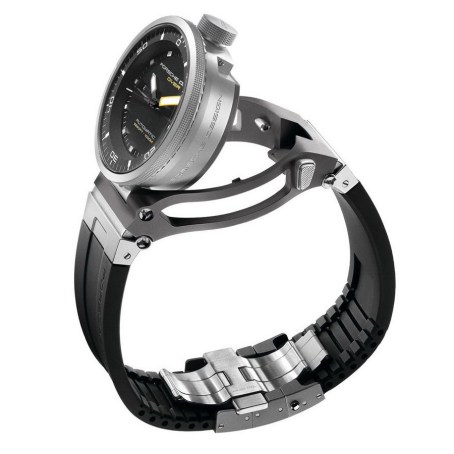
Eterna Porsche Design P’6780 Diver Watch

The brand “Porsche Design” is synonymous with its automotive brother from Stuttgart, in that they’re both known for high-tech, sleekly styled machines that offer a uniquely Teutonic perspective with regards to their form and function. Perhaps no such timepiece from PD (made for them by the Eterna company) represents this better than the P’6780 Diver. Unlike any wristwatch you’ve seen, the entire case lifts up, ostensibly for better viewing when you’re a few hundred feet below. Yet, this contraption isn’t heavy because it’s hewn from titanium, with a natural rubber strap. The perfect watch for when one is at the wheel of a Carrera GT or underwater at the wheel of a 928 (Risky Business fans, that one’s for you).

A Photo I Made

Posted in Photos, Wristwatches on February 3, 2012 by RickNews

Shot with a Nikon D3100.

Monaco: Glitz, Glamour, and Speed

Posted in Automobiles on February 3, 2012 by RickNews

I attended the Grand Prix of Monaco in 2003 and here is the article that Elements Magazine published..

(All photos by Richard S. Hollander)

For more photographs, visit http://RickSH.com/monaco

Monaco's famed harbor.

Monaco has given the world two lasting things that will forever set it into the glamorous jewelry of the world’s psyche: One is the fairy tale romance that brought Hollywood’s most beautiful actress across a sea and turned her into a princess with glitz, class, and Grace. The other is an automobile race through the streets of the small principality that’s been since 1928. Princess Grace—Grace Kelly from Philadelphia—hasn’t been with us for almost 30 years, yet everywhere one goes in Monaco, her presence is felt on street signs and posters. The Grand Prix of Monaco, the most glamorous sporting event in the world, comes for only three days a year yet it is burned into our consciousness as the ultimate sporting event, combining speed and scenery.

The most famous casino in the world.

Shining Through

Monaco is truly a tiny gem of a place that, if it didn’t already exist, some mega-developer would have to create it. Yet, the most “mega” of developers did—God. Nestled on the Cote d’Azur, Monaco’s topography is best described as “San Francisco compressed.” Just as one must hike the streets of San Francisco, Monaco’s streets make for strong calf muscles. Peppered throughout the principality, there are “public stairways” and elevators. Those with experience tell the virgin traveler to Monaco, “You can’t just get from point ‘A’ to point ‘B,’” and they’re right—especially during the week that the tiny nationlet is transformed into a Grand Prix venue. Streets are closed to most, unless you have a ticket from the race organizers granting you access to a particular thoroughfare. Approximately 30,000 people live in Monaco year-round, in this 485-acre realm.

The jagged cliffs of Monaco.

Yet Monaco is a gorgeous place that instills magic in the heart of visitor and racing fan alike. We’ve all seen James Bond tool around the winding streets of Monte Carlo and leap from a flashy sports car into the Casino. When one’s eyes first glimpse the ornate palace of gambling, for a fleeting moment you, too, can be “Bond, James Bond”…or if you’re of the female persuasion, Pussy Galore. The famed harbor is breathtaking: here in a cocoon of azure waters, and floating like platinum sardines, are billions of dollars worth of ships. During Grand Prix week, the ships are packed so tightly, it’s possible to leap from one floating party to another. However, the grandest dame in the entire harbor belongs to Prince Rainier himself. Docked just outside of the harbor entryway was one of the most expensive private yachts in the world, the Lady Moura, which is owned by an advisor to the King of Saudi Arabia. Complete with a helicopter and brimming with high-tech goodies, the Lady Moura symbolizes everything about the Grand Prix of Monaco: if you’re not there, you’re not truly among the jet set (floating palace set?).

Outside Prince Rainier's car museum.

Money Doesn’t Talk Here…It Raises Its Voice Above the Din

Everyone who is anyone attends this, the glitziest, fastest event of the billionaire’s social calendar. Rock stars, supermodels, idle rich, and business barons all come to the Grand Prix. The streets are literally crammed with the most expensive automobiles in the world. I saw two million-dollar Mercedes GTR race/street cars; a shining-new Rolls-Royce Phantom ($340,000) parked on a sidewalk; a Ferrari Enzo (about $650,000); a Bugatti EB110 (around $400,000); and multitudes of Lamborghinis, Porsches, Bentleys, and “ho-hum” BMWs. Many of these cars can be ogled sitting in front of the Café de Paris, juxtaposed between the Monte Carlo Casino and one of Monaco’s only shopping malls, Le Metropole.

If “money talks,” then for the three days of F1 racing in Monaco, money has a wail that’s higher-pitched than the race cars’ engines. Sitting under the hot Riviera sun at the Café de Paris, one is surrounded by the movers and shakers of the F1 circus. There are team principals, hangers-on, and the hangers-on’s assistants and they’re all watching the parade of cars, models, hunks, and tourists circle around, like fish in a crystal bowl. As you wait for a busy Monegasque waiter to grace you with his presence, there are deals going on at tables within earshot that’d make Warren Buffett blush. While I was sitting at the CdP, the highly exclusive Dutch sports car manufacturer, Spyker, was giving test drives in its hand built C8. I was told that Spyker had sold two of the C8s that day alone. The price for this two-seater sans roof: about $240,000.

Rich in the Spyker.

While Daddy Warbux is spending pocket change on a European super car, his “better half” can shop in the most exclusive stores in the world. Cartier, Prada, Bulgari—there are more than a few emporiums where a hundred grand can be spent in minutes. Art galleries pepper the storefronts and if your tastes run a little larger than a Matisse or a Picasso, there’s always one of Monte Carlo’s myriad yacht brokers who will be glad to fit you into something seaworthy.

Staying…In Style

Monaco is home to the legendary Monte Carlo Grand Hotel, which is ranked in the top five hotels in Europe. Formerly called the Loews Monte Carlo, the MC Grand is located directly on the sea, and it’s a chip’s throw from the Monte Carlo Casino. During the Grand Prix, the place to stay and be seen is the MC Grand; I even bumped some of the Ferrari team’s members there. The MC Grand also features its own casino, spa, pool, and every other amenity you can think of. Well, here’s an amenity you probably wouldn’t think of: the MC Grand is on the aptly named “hairpin” turn on the race course, and out in front of the lobby, lucky guests can view the sleek F1 cars straining to keep a grip as the legendary turn is negotiated. Another noteworthy place to stay is the Hotel Columbus, which is along the lines of a modern “boutique hotel” that we’ve become accustomed to in most of America’s large cities. The Columbus is on the opposite side of Monaco from the Monte Carlo Grand, yet it’s quickly becoming the spot where the tres cool hang out, because one of its owners is the Scottish former F1 racer, David Coulthard.

The most famous hairpin turn in racing.

Les Americaines!

Despite what you may have heard about the French and their alleged “attitude” concerning foreigners and Americans in particular, I didn’t run into anyone in Monaco who wasn’t polite and helpful. In fact, the Monegasque police were some of the nicest lawmen I ever met. They all spoke English and all were helpful in assisting my navigation of their not so humble burg. After the race was over, I even saw a police officer handing out hors d’ouevres on the street! A new municipal perk? Hardly, but at least he was sharing his food, unlike an American cop with a donut. Maybe it has something to do with the new generation of Royals being half American, but as I swaggered around Monaco, I couldn’t help but think to myself that not only should I be welcomed with open arms as a tourist, but also as a countryman to their beloved Princess Grace.

The Monegasque police are so friendly: this chap was handing out hors d’ouevres.

Electricity In The Streets

On the three days that there are incredibly fast machines prowling Monte Carlo’s city streets, Monaco is transformed into the world’s most expensive, lavish, and exclusive race course. The Grand Prix of Monaco is run on Sunday, but the two days leading up to the main event are no less filled with excitement. The first day, Thursday, is Formula 1’s testing day for four teams and a practice day for the rest. One should get to the “track” early on each day, as things get crowded quickly. The first time I heard the barbaric shriek of 20,000-RPM thoroughbred race engines reverberating against the medieval walls of Monaco, I didn’t get goose bumps—I got foie gras bumps! There is no location within the principality that can escape the noise of the F1 cars. (If you’ve never heard a Formula 1 racing engine at full throttle, try to imagine your Cuisinart dialed to “11”…on a loudspeaker the size of King Kong’s head…then multiply that noise by 100.)

There are several grandstand locations around the street circuit that afford terrific viewing. However, the best place to see the Grand Prix is from an apartment balcony overlooking the course. Don’t have a friend with a pied a terre in Monaco? No problem—you can go through a travel agency and they’ll arrange a prime location on a prime balcony in a prime apartment building for you. They will provide you with delicious vittles catered from a nearby restaurant. Sure, it costs a little more, but as the saying goes, it’s well worth it. After all, if you’re going to “do Monaco,” do it right.

A view from the balcony.

The balcony position I reserved was directly overlooking the Beau Rivage straightaway with a terrific view of the famed Sainte Devote corner. Cars would accelerate from start/finish line, break heavily at Sainte Devote, then, like a rocket ship, they’d zoom down the Beau Rivage. About a half-minute later, they’d come back into my view along the harbor portion of the course and do a wicked dance into the Piscine chicane, which is next to Monaco’s Olympic-sized swimming pool complex, and they’d speed away into the unknown. Schumacher’s Ferrari, Montoya’s Williams-BMW, and Coulthard’s McLaren-Mercedes sped by so close to me that I could see the stitching on their uniforms clearly…as I munched on a shrimp and couscous salad while sipping a cold beer served to me by a polite waitperson. Hey, if you’re going to do Monaco, do it right.

On the Friday before a race, the track is closed, so it’s a perfect opportunity to explore the principality. If you’re a car enthusiast like myself, Prince Rainier’s automobile collection (called the Collection Voitures Anciennes de S.A.S. Le Prince de Monaco) is not to be missed. For a relatively low admission of about eight dollars per person, you can feast your eyes on Rainier’s vintage vehicles, ranging in age from about 100 to almost brand-new. The museum even has the wedding car (a Rolls-Royce, naturally) that Princess Grace and her beau rode in on the day of their nuptials. Other sites to see include the Casino, the gorgeous exotic gardens, one of the planet’s most acclaimed oceanographic museums, or you can simply stroll along the harbor and soak up the money vibes given off by those magnificent yachts. Fancy a drink? If you’ve already done the Café de Paris, park yourself at Stars ‘N’ Bars, which is a good ole American bar in the stately city.

Floating F1 fun!

Saturday is the main qualifying day for the Formula 1 cars: each driver gets only one lap to reserve his position on the race’s starting grid. If a driver errs on the bumpy, tight turned track, he doesn’t get a second chance. The air is tense on Saturday, for driver and fan alike and this is when it hits you: Yes, you really are at the Grand Prix of Monaco and you really are party to a very special event on this big, blue marble.

The final day of festivities is Sunday and no sporting event you’ve ever experienced is like the running of the Grand Prix of Monaco. None. I can best describe it as the Indy “500,” the Super Bowl, and the final game of a World Series rolled into one deliciously smooth crepe.  First of all, start early on Sunday, and if you’re not in your seats (or on your balcony) by 10 AM, you’ll be dealing with Monaco’s narrow, crowded streets, and you may get your J.P. Tod’s stepped on (or step on someone else’s). Besides, there’s a driver parade two hours before race time, at noon. Loaded on to a flatbed truck are a few hundred million dollars worth of prime steering meat, and to have a pilote wave back at you…well, that’s heartwarming to any race fan.

Close to the action.

The race begins at 2 PM sharp. After the cars have done a couple warm-up laps, they all must wait, stationary, as five red lights illuminate. As the lights are activated, the engines’ revs build…louder and louder these Secretariats of the streets become as they wait for the red lights to extinguish, thus signaling the start of the race and the unleashing of the hounds of hell. From the start line, the field of 20 cars speed down to Sainte Devote and through that tricky corner—some will make it and some may not. The first time a Formula 1 car races by you in the anger of competition, a bolt of electricity will shatter you and you’ll be taken back into time: A time when the gods of racing, like Fangio, Clark, and Senna all attempted to tame the streets of Monte Carlo. It’s at this instant, as your body reverberates from the terrific sound, that you realize by being here in Monaco, you are now part of history with a capital “H.” You’ll be able to delight your friends and amaze your grandchildren by saying you attended the Grand Prix of Monaco. Best of all, the memories are everlasting in this fairy tale kingdom.

Dieting, the RickNews Way

Posted in General Interest on February 3, 2012 by RickNews

Perhaps the most important aspect in maintaining one’s weight is to limit portion control. After all, it makes sense: limit the amount of food on your plate and you’ll eat less.


However, RickNews readers usually like to go “one better” in all areas of life, so I suggest limiting your limited portions by cutting your food into “hors d’oeuvres size.” For example, instead of eating two pizza slices and a soft drink for lunch, have one slice and cut it up into bite-size morsels.

I like to take the experience up a notch so I bring my own toothpicks with me wherever I go. Try it—your one lonely slice of the Neopolitan delicacy suddenly is transformed into about 30 toothpick-topped hors d’oeuvres!

Not only is this easier on your waistline, but you can pretend that you’re at a cocktail party, three times a day. Who wouldn’t want to make each meal a healthier and more festive occasion?